
Geothermal Heat Pump Installation Cost in New Jersey
Most geothermal heat pump installations cost $20,000 to $50,000 or more, per the national cost guide HomeGuide. Big homes and hard drilling conditions sometimes push the price past $75,000. Those are installed prices for the whole system.
That total covers two trades. The ground loop is the drilling side, and it is the part D.N. Drilling does. That means the boreholes, the loop pipe, the grout and the header trench to the wall. We also pull the NJDEP well permit.
The heat pump and the ductwork inside the house are your HVAC contractor’s side. We do not sell or install heat pumps. Our geothermal loop drilling service covers everything in the ground, and the estimate is free.
What does a geothermal heat pump cost by home size?
HomeGuide sorts its 2026 installed prices by the size of the house. Larger homes need more heating and cooling capacity, and that raises the cost.
| Home size (square feet) | Average cost installed |
|---|---|
| 1,200 to 1,500 | $15,000 to $23,000+ |
| 1,500 to 2,000 | $18,000 to $28,000+ |
| 2,000 to 2,500 | $20,000 to $36,000+ |
| 2,500 to 3,500 | $30,000 to $50,000+ |
| 3,500 and up | $40,000 to $75,000+ |
These are national figures. Your HVAC contractor’s load calculation sets the real size of the system, in tons. The tonnage tells us how much bore to drill, and our estimates are free.
How much of the bill is the heat pump itself?
HomeGuide prices the heat pump unit alone at $3,500 to $14,000 before installation. Heat pumps are sized in tons, and each ton equals about 12,000 BTUs.
| Heat pump size | Unit price | Installed cost |
|---|---|---|
| 2 tons | $3,500 to $7,000 | $15,000 to $20,000+ |
| 3 tons | $5,000 to $8,000 | $18,500 to $28,000+ |
| 4 tons | $6,500 to $10,000 | $20,000 to $36,000+ |
| 5 tons | $7,500 to $12,000 | $30,000 to $50,000+ |
| 6 tons | $9,000 to $14,000 | $38,000 to $75,000+ |
The installed price adds the labor and the ground loop to the unit. HomeGuide says labor makes up 50% to 70% of the installed cost.
The house itself moves the number too. New construction installs often cost 20% to 40% less than retrofits of existing homes, per HomeGuide. In an existing house, ductwork changes can add $1,400 to $5,600 or more.
Which part is the ground loop, and which part is the HVAC work?
The line between the two trades sits at the building wall. Everything in the ground is drilling work. Everything past the wall belongs to the heat pump contractor.
| Part of the job | Who does it | Published cost or what sets it |
|---|---|---|
| Load calculation and system design | HVAC contractor | Sizing and design fees often add $500 to $1,000+ (HomeGuide) |
| Heat pump unit | HVAC contractor | $3,500 to $14,000 before installation (HomeGuide) |
| Ductwork changes | HVAC contractor | $1,400 to $5,600+ (HomeGuide) |
| Electrical upgrades | Electrician | Older homes may need them (HomeGuide) |
| Boreholes, loop pipe and grout | D.N. Drilling | Bore count and depth, set by the tonnage, plus rig access |
| Header trench to the wall | D.N. Drilling | Distance from the loop field to the house |
| NJDEP well permit | D.N. Drilling, signed with you | Required before any drilling |
| Lawn repair after the work | Ask each contractor | Landscaping runs $50 to $100+ per hour (HomeGuide) |
HomeGuide says geothermal projects take 1 to 8 months from contract signing to completion. Many homeowners line up the HVAC contractor first. Ask them for the loop design or the tonnage, then call us. We price the ground side from that, and the estimate is free.
How does the loop type change the price?
HomeGuide also prices the whole installed system by loop type. Your lot and your soil decide which type fits.
| Loop type | Average cost installed |
|---|---|
| Horizontal loops | $20,000 to $50,000+ |
| Vertical loops | $25,000 to $80,000+ |
| Pond loops | $25,000 to $45,000+ |
| Open loops | $15,000 to $35,000+ |
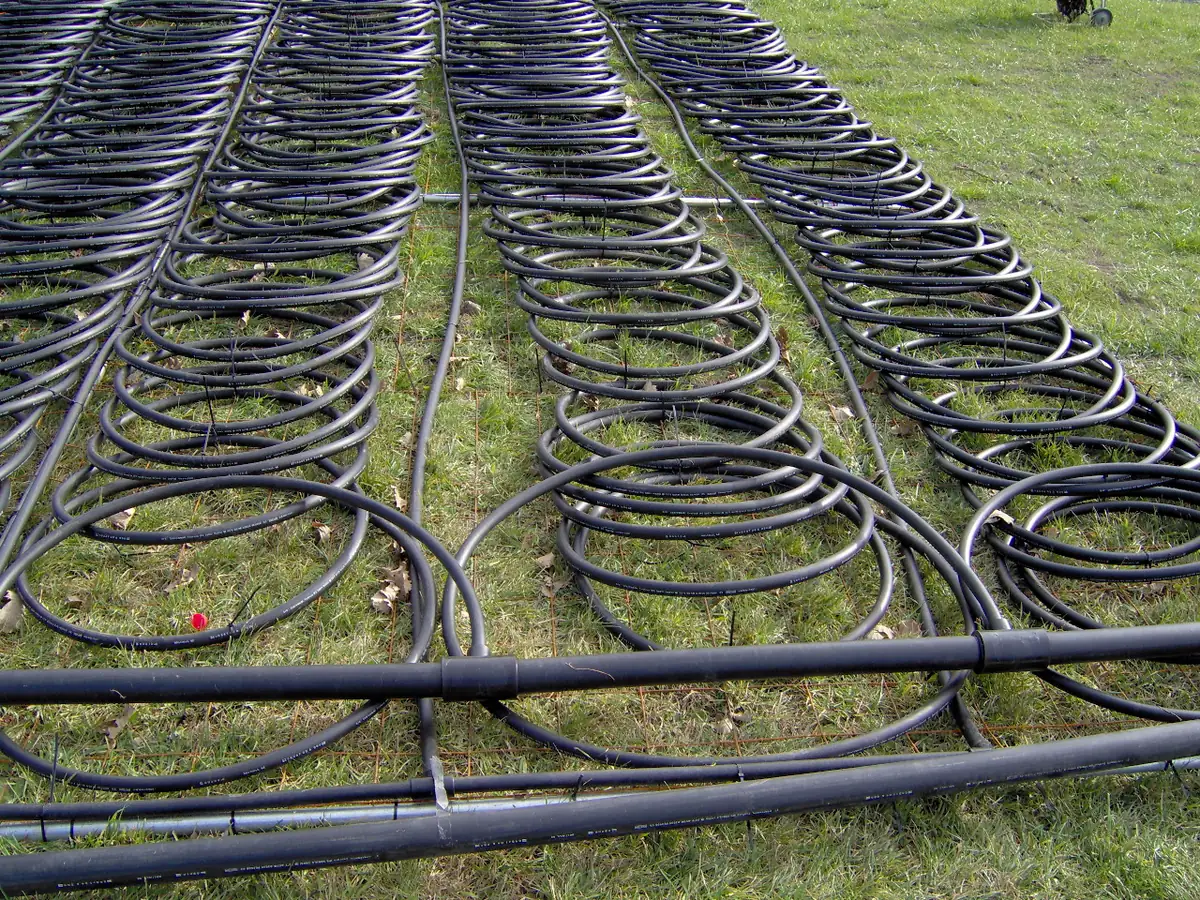
Horizontal loops need at least a quarter acre, laid in trenches about six feet deep. HomeGuide says they cost less because they avoid expensive deep drilling. Vertical loops use boreholes 100 to 400 feet deep, spaced 10 to 20 feet apart. Most homes need three to five boreholes, which costs more but suits a smaller lot.
An open loop feeds the heat pump from a supply well. A return well puts the water back. HomeGuide notes open loops may carry extra permitting costs. For the supply side, see what a new water well costs in New Jersey.
Sometimes an existing water well can feed the system, so we test it first. When it cannot hold the flow, we drill a new well to a better-producing zone. If that leaves the old well out of use, our well abandonment service seals it from the bottom up.
Why does South Jersey sand suit a vertical loop?
Much of South Jersey sits on the Kirkwood-Cohansey aquifer system, layer after layer of sand and gravel. Sand drills faster than rock, and faster drilling means fewer rig hours for each hole. The ground is also wet through most of the region. Saturated sand moves heat better than dry sand, so each foot of bore does more work.
HomeGuide says installs tend to cost less in sandy or loamy soil, while rocky ground may need special drilling equipment. New Jersey’s rules treat the two differently too. The state sets separate grout rules for bores in loose sand and gravel and for bores in rock.
What do New Jersey’s well rules add to a geothermal job?
Every geothermal bore is a well under state rules. Before drilling, you and a licensed well driller of the proper class must sign and obtain an NJDEP well permit. We pull it before the rig arrives, and you get a copy before drilling starts.
Each bore needs a permit, though a site-wide permit can cover 10 or more wells that work as one system. Closed-loop geothermal is on that list. A geothermal well permit is valid for one year from the date it is issued. If the bores are not drilled in time, a new permit comes first.
New Jersey classes vertical closed loop bores as Category 5 wells, with their own construction rules. It even licenses a separate class of driller for them. Once the hole is done, the grout pipe goes to the full drilled depth. The whole space between the loop and the borehole is then pressure grouted through that pipe, from the bottom up.
Is there a federal tax credit or a rebate for geothermal in 2026?
A 2026 install gets no federal 30% credit. The IRS Residential Clean Energy Credit was 30% of the cost of qualified property. It covered systems installed from 2022 through December 31, 2025. Geothermal heat pumps qualified if they met ENERGY STAR requirements.
The IRS says the credit is not available for any property placed in service after December 31, 2025. Some cost guides still show the old credit, so price your project without it.
Atlantic City Electric customers have a rebate to check. Its HVAC Efficiency program lists a geothermal heat pump rebate of half the project cost, up to $10,000. It applies only to customers replacing an electric heating system. Homes replacing fossil fuel heat are sent to a separate building decarbonization program.
The heat pump must be an ENERGY STAR model installed by a participating contractor. The paid invoice must be dated between January 1, 2025 and June 30, 2027. Confirm the current terms with your electric company before you sign.
What does geothermal cost to run, and how long does it last?
HomeGuide puts geothermal heating at $50 to $200 a month on average. Heating and cooling a well-insulated 2,000 square foot home averages $50 to $80 a month with a properly sized system. Larger homes, or those with poor insulation, run closer to $100 to $150 or more.
HomeGuide says a well-maintained indoor unit lasts 20 to 25 years. The underground loops can last 40 to 60 years. A standard heat pump lasts 10 to 15 years on average.
We run out of Vineland and Clayton and drill loop fields across South Jersey. Call (856) 207-7373 for a free estimate on ground loop drilling for your geothermal system.